Marbella’s General Plan: PGOM & POU Approval & Explained in 2026
After 15 years without a valid urban plan, Marbella has just reached a turning point. The city’s new General Plan, the PGOM, has received formal approval from the Junta de Andalucía, making Marbella the first municipality in Andalusia to achieve this under the new LISTA framework. Read about the PGOM and POU progress, details and what it means in practice.
After decades in the making, Marbella approved its new General Plan (PGOM) on 18 September 2026, setting a long-term framework for land classification, housing, green space and infrastructure across all six districts of the municipality.
Marbella Golden Mile aerial image
After four decades under a plan drafted in the 1980s, Marbella now has a planning framework written for the city it has become. This article explains what has been approved, what the plan proposes in each part of Marbella, what still has to happen before anything is built, and what it means for owners, buyers and sellers.
Marbella’s New General Plan: Final Approval
On 18 September 2026, Marbella’s town council gave final approval to the Plan General de Ordenación Municipal (PGOM) at an extraordinary plenary session. The governing PP group voted in favour, together with OSP and VOX, and PSOE abstained. VOX backed the plan while noting that its vote did not signal agreement with every provision, and PSOE called a new plan necessary but raised specific objections during the debate. Marbella is the first municipality in Andalusia to approve a general plan under the region’s LISTA planning law.
The vote followed a favourable report from the Junta de Andalucía in February 2026, and the council noted that the plan had passed every stage of review with all reports in its favour. Mayor Ángeles Muñoz described the plan as the start of a new stage for the city. The councillor for planning, José Eduardo Díaz, stressed that approval is a starting point rather than the end of the process.
One distinction matters in practice. The plan has been approved, but it takes legal effect once it is published in the official gazette, and no publication date has been confirmed yet. One industry legal reading of the file’s procedural clock, based on the initial approval in March 2023 and two subsequent suspensions rather than any official statement, puts a three-year statutory limit under LISTA at the end of September 2026, which would point to publication news arriving around then. Until publication, and for property-level rules until the POU is complete, current regulations continue to apply.
The Andalusian LISTA Framework: PGOM and POU
LISTA, the Ley de Impulso para la Sostenibilidad del Territorio de Andalucía, replaced the old single-document PGOU with two separate instruments.
The PGOM (Plan General de Ordenación Municipal) is the strategic document. It classifies all land in the municipality, sets where growth can and cannot happen, protects natural areas, and reserves space for major infrastructure, parks and public facilities. In international terms, it is the city’s urban master plan.
The POU (Plan de Ordenación Urbana) is the detailed document that follows. It will set zoning rules, permitted uses, building heights, density and plot ratios for individual areas. This is the document an architect or conveyancing lawyer will consult when assessing a specific property. Marbella’s POU is currently being processed. Its environmental scoping stage was completed in October 2025, and final approval is expected in 2027 or 2028.
Differences between PGOM & POU under the LISTA framework in Andalusia
Marbella General Plan History
Until now, Marbella’s planning has been governed by a plan approved in 1986. Think about what Marbella looked like then: before the beach clubs, the luxury urbanisations, the golf communities and the international developments that define the city today. The city has become one of Europe’s most coveted lifestyle destinations, while the official planning rulebook failed to keep pace.
In 2010 the city approved a replacement plan designed to modernise the rules and regularise thousands of homes. In 2015 Spain’s Supreme Court annulled it on procedural grounds, and the city reverted to the 1986 framework.
The consequences were real. Around 18,000 homes were left outside full planning regularity, built under licences tied to rules that no longer applied. This complicated due diligence, mortgage assessments, renovations and resales for years. The new PGOM was drafted under LISTA precisely to avoid the procedural weaknesses that brought down the 2010 plan.
What the New PGOM Changes Across Marbella
The headline change is the amount of land classified as urban. The PGOM recognises 53 million m² of urban land, compared with roughly 40 million m² under the previous framework. Of the 117 million m² municipal territory, 64 million m² is rustic land, and around 30 million m² of that can be transformed under the rules.
That figure is easy to misread. Most of the additional urban land is existing, built-up fabric that the old plan never classified correctly. It is not 13 million m² of new building plots.
The plan also links growth to housing policy. Actions within urban land must reserve 20% of buildable floor space for affordable housing, and 40% of transformable rustic land is reserved for protected housing. In practice, most large new neighbourhoods will include a significant share of protected and price-controlled homes.
Green City plan from Marbella’s PGOM 2026
Infrastructure is tied to development rather than left to follow it. New growth depends on available water, sanitation and energy capacity. The plan reserves land for a future rail connection, new road links, an expanded cycle network and additional parking. A reserved rail corridor does not mean a railway is imminent, but it keeps that option open. A network of green corridors along the city’s streams is also planned to link the mountains with the coast.
Two further points matter for anyone with property in Marbella. First, the plan does not suspend licences or planning procedures anywhere in the municipality: planning instruments approved or in progress under the 1986 plan are carried forward, with deadlines for completion. Second, some land classified as urban in 1986 is now rustic. These are mostly edge cases involving coastal and road public domain or protected river corridors, but they are a reason to check the classification of boundary plots carefully.
Mobility and connectivity system from Marbella’s PGOM
What Marbella’s PGOM Proposes, District by District
The plan divides Marbella into six districts, each with its own strategic identity and a list of specific intervention areas. The descriptions below are based on the plan’s final proposal documents.
San Pedro Alcántara: Its Own Identity
The priorities for San Pedro are a green ring around the town, landscape protection for the Las Medranas reservoir, urban regeneration and an upgraded seafront. Named intervention areas include Arroyo del Chopo, El Ingenio, Nueva Alcántara, Jorge Guillén, Camino de la Granadilla, the west bank of the Guadaiza river and El Potril. El Potril, a long-standing irregular settlement north of the Guadaiza, will be addressed through a special plan, the first draft of which was published in July 2026.
For buyers, this supports what San Pedro has been doing for some years: becoming a self-contained town with better public space rather than a dormitory suburb.
Nueva Andalucía and Puerto Banús: The Planned City
The plan aims to consolidate La Campana as an urban core, create new centres of activity, and extend the pull of Puerto Banús into the rest of Nueva Andalucía. Named intervention areas are La Campana, El Rodeo, Holanducía and Guadaiza Oriental. A new Ciudad de la Educación y el Conocimiento, intended for training, higher education, student residences and innovation, is planned near the Guadaiza river.
For owners, the direction is densification and better services around existing centres rather than expansion into the hills. Separately from the PGOM, the council is also removing six high-voltage pylons and burying around two kilometres of lines in the area.
Nagüeles and the Golden Mile: Distinction and Exclusivity
The Golden Mile is largely built out, and the plan treats it accordingly. Priorities are better connections around the A-7 and AP-7, a stronger green infrastructure network, improved public space along the old N-340, and unblocking historic urbanisations whose development has been stalled by planning uncertainty. Named intervention areas include Viña del Marfil, Los Verdiales, La Caridad, the Nagüeles ring road and the Istán road.
For owners, the significance is clarity rather than change. Expect gradual renovation and selective redevelopment of older properties, with the character of the area protected.
Strategic proposals for San Pedro, Nueva Andalucía and the Golden Mile. Source: PGOM Final Proposal, Plan O.05
Marbella Town: Heritage and Innovation
In central Marbella, the plan focuses on neighbourhood regeneration, river parks linking the sierra to the sea, and closing the gap created by the AP-7 between Valdeolletas and El Mirador. Named intervention areas include the historic centre, La Ermita, Albarizas, Arroyo del Tejar, Camino de los Molinos, a new Ciudad de la Justicia and Arroyo Segundo.
Arroyo Segundo is the most advanced of the new neighbourhoods. Located between La Cañada, La Ermita, Bello Horizonte and the A-7, it covers around 365,000 m² and proposes 1,330 homes, 532 of them protected, along with a green ring, a transport centre and a new city fairground of 70,000 to 80,000 m². Its delimitation has received initial approval and is on public exhibition. The promoters estimate around 25 months of planning and 14 months of urbanisation works before home construction can begin.
Map of Marbella PGOM 2026 Strategic Plan
Río Real, Realejo and Siete Revueltas: The Garden City
This district’s priorities are continuity of the coastal path, better links between urbanisations, green infrastructure, a new connection between the AP-7 and A-7, and new local centres. Named intervention areas are Arroyo Alicate, Río Real and Los Molineros. Developments already in progress under the old plan, including Golf Río Real Phase 2 and the El Realejo and Siete Revueltas sectors, are carried forward. New parks are proposed along the Realejo and Siete Revueltas streams.
Las Chapas: Nature at Its Most Extreme
East Marbella is where most new housing will eventually be built. Days before the PGOM vote, the council gave final approval to the delimitation of three large areas:
La Vizcaína, around 623,000 m² between the AP-7 and the coast, with 685 to 872 homes (40% protected or affordable rental), land for a supramunicipal education facility and hotel plots.
La Víbora (Coto Correa and La Arquería), a private initiative reported at 2,776 homes, 40% of them protected.
Alicate, La Paz and Arroyo Sequillo Este, north of the A-7, promoted by the Holiday World group and proposing close to 2,800 homes and a five-star Gran Lujo hotel.
Together these areas cover around 3 million m², with capacity reported at about 6,500 homes. Delimitation fixes the boundaries of each area. It does not approve the detailed layout or authorise building, and each area still faces detailed planning, infrastructure and urbanisation stages.
The wider strategy for Las Chapas includes coastal path continuity, walking and cycling routes, new centres of activity, and unblocking historic urbanisations. Named intervention areas are Ricmar, Pueblo Platero, Pueblo Andaluz, Arroyo Sequillo, Cabopino and Santa María. The plan also reserves land for a new secondary school in Las Chapas.
Marbella to Rio Real and Las Chapas, Marbella PGOM 2026
From Plan to Keys: The Realistic Timeline
A classification in the PGOM is the first of several stages. For a new neighbourhood, the sequence runs from delimitation, to detailed planning, to reparcelling and urbanisation works, and only then to building licences and construction. Arroyo Segundo, the most advanced of the new areas, still estimates more than three years before homebuilding begins.
For existing urban areas, the key milestone is the POU. Until it is approved, detailed rules for individual properties remain those of the current framework. The PGOM sets the direction; the POU will set the specifics.
Bahía de Marbella, East Marbella
Implications of Marbella’s New Plan for the Property Market
The PGOM will not move prices on its own. What it changes is confidence, and that tends to show over years rather than weeks.
For existing owners, the plan strengthens the legal footing of property rights and gives a clearer basis for resolving the status of homes affected by the 2015 annulment. Resolution is not automatic, and each case will depend on its own history.
For buyers in established prime areas such as the Golden Mile, Sierra Blanca and central Nueva Andalucía, supply will stay constrained. The new housing is concentrated in the east and around Arroyo Segundo, and a large share of it is protected or affordable. That serves a real need in the city, but it will not add meaningfully to the luxury market.
For buyers considering East Marbella, the trade-off is worth weighing honestly. Over the coming decade the area will gain schools, parks, road connections and local centres. It will also see years of construction on a significant scale. Anyone buying near La Vizcaína, La Víbora or the Alicate sector should look at the plans for their immediate surroundings as well as the property itself.
For sellers, a clearer planning environment removes a long-standing source of buyer hesitation, particularly for older properties. It is not, however, a reason to raise asking prices in isolation. Value still depends on location, condition, legal status and genuine demand.
For developers and land investors, the plan makes the pipeline more predictable, but classification is not a right to build. Density, uses and timing will be settled in later instruments.
What This Means for Buyers Right Now
Legal due diligence matters as much as ever during the transition. A qualified Spanish property lawyer should check the property’s classification under the new PGOM, its licensing history, whether it sits near a boundary where classification has changed, and what is planned for surrounding land. Where planning status is a live factor in a transaction, the purchase contract can allocate risk through conditions, price adjustments or exit rights tied to specific milestones.
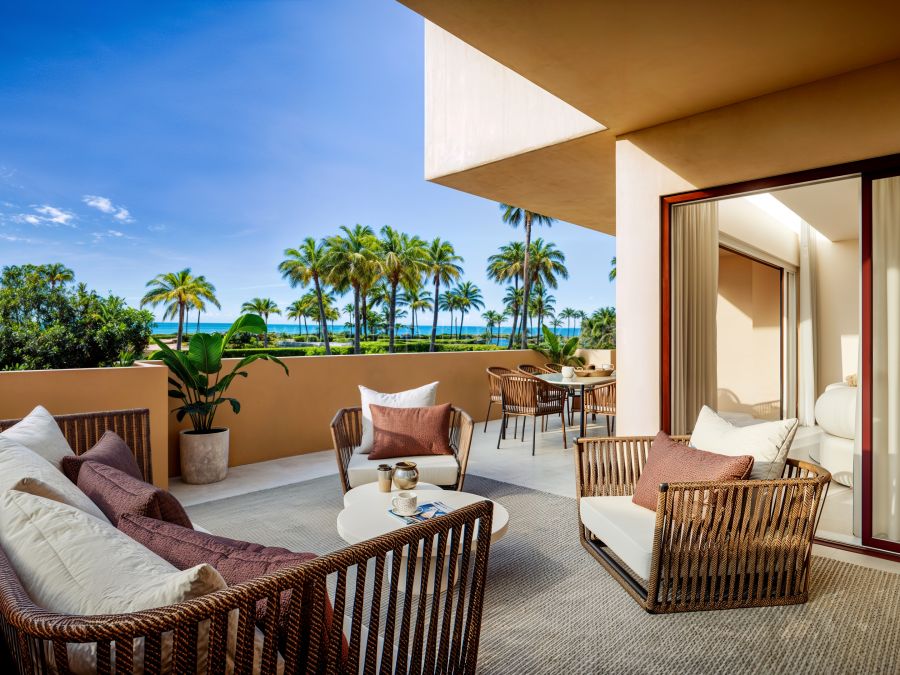
Beachfront terrace in Marina Puente Romano, Marbella Golden Mile
Final Reflections on Marbella’s New Urban Plan
We have worked in this market for more than twenty years. We watched Marbella absorb the 2015 annulment and keep growing, with buyers, lawyers and developers working around the gaps. The new General Plan finally addresses the source of that uncertainty.
The plan is ambitious, and much of it will take a decade or more to deliver. Its value lies in something simpler: for the first time in a generation, anyone looking at Marbella can see where the city intends to grow, what it intends to protect, and how the pieces are meant to connect. For a market that competes internationally with destinations like London, Dubai and Nice, that transparency matters.
If you own a property that has been affected by past planning uncertainty, now is a good time to review its position with a lawyer who knows Marbella’s planning history well.
Note: This article is for general information only and does not constitute legal, planning or investment advice. Readers should obtain independent advice from a qualified Spanish property lawyer before making any decision. It is based on publicly available sources, including the PGOM final proposal documents, Marbella Town Hall’s official statements, and contemporary reporting from El Español, Europa Press and Euro Weekly News, current at the time of publication in September 2026.
Frequently Asked Questions
Has Marbella’s new General Plan been approved?
Yes. Marbella’s town council gave final approval to the PGOM on 18 September 2026, following a favourable report from the Junta de Andalucía in February 2026. The plan takes legal effect once it is published in the official gazette.
What is the PGOM in Marbella?
The PGOM (Plan General de Ordenación Municipal) is Marbella’s strategic urban plan. It classifies all land in the municipality, sets where growth can happen, protects natural areas and reserves land for infrastructure, parks and public facilities. It replaces the general provisions of the 1986 plan.
What is the difference between the PGOM and the POU?
Under Andalusia’s LISTA law, the old single general plan (PGOU) is replaced by two instruments. The PGOM sets the strategic framework for the whole municipality. The POU sets detailed rules for urban areas, such as heights, density, permitted uses and plot ratios. Marbella’s POU is still being processed.
What is LISTA?
LISTA is the Ley de Impulso para la Sostenibilidad del Territorio de Andalucía, the regional planning law passed in 2021. It is designed to simplify and legally strengthen urban planning across Andalusia. Marbella’s PGOM is the first municipal general plan approved under it.
Where will new homes be built in Marbella under the PGOM?
Most new housing is planned in East Marbella, in the La Vizcaína, La Víbora and Alicate, La Paz and Arroyo Sequillo areas, and at Arroyo Segundo, between La Cañada and Bello Horizonte. A significant share of these homes will be protected or affordable housing.
Does the PGOM legalise the 18,000 affected homes?
Not automatically. The PGOM provides a legal framework for resolving the status of homes affected by the annulment of the 2010 plan, but each property’s outcome depends on its individual circumstances. Advice from a Spanish property lawyer with Marbella experience is essential.
Are building licences suspended while the new plan comes into effect?
No. The PGOM does not suspend planning procedures or licences anywhere in the municipality. Planning instruments approved or in progress under the 1986 plan are carried forward, with deadlines for completion.
Does Marbella’s PGOM apply to Benahavís or La Zagaleta?
No. Benahavís, including La Zagaleta, is a separate municipality with its own planning system. Marbella’s PGOM applies only within Marbella’s municipal boundaries, which include San Pedro Alcántara, Nueva Andalucía and Puerto Banús.
Will the new plan push property prices up?
Not immediately. The PGOM creates planning certainty, which supports confidence and market activity over time. Prices will continue to depend on location, quality, legal status and demand, and on the detailed rules the POU sets for each area.
Buying, selling or investing in Marbella and want to understand what the new General Plan means for your property? The MPDunne team has advised clients in this market for over 20 years. Get in touch for a straightforward conversation.
Melinda is an experienced writer specialising in real estate, urban planning, lifestyle, architecture and design. A seasoned Marbella resident, she holds an Undergraduate Degree in Social Science with Honours in Politics, and a Masters degree in Urban Planning.
Marbella’s property market is experiencing a surge in luxury branded residences: high-end homes developed in partnership with famous fashion, design, or automotive brands. As the trend continues, discover the history, offerings & investment future of globally branded homes in the Marbella and Costa del Sol area.
In recent years, the Costa del Sol property market is shifting towards new-build homes. Flexible payment terms, luxury modern communities with resort-style facilities, and the prospect of capital appreciation from launch to completion are driving buyers away from resale and toward off-plan. Here is what that shift looks like on the ground, and why it shows no sign of reversing.
With an increasing number of high-net-worth individuals choosing to invest in Marbella, and the Costa del Sol area, the market is responding by delivering a stylish range of new developments located in central areas that cater to modern tastes and preferences. Discover our pick of some of the best new build properties currently on offer.